The
year 1993 marked the existence of 300 years of Amish life. Extinct in
their European homeland, today they live in more than 200 settlements
in 22 states and the Canadian province of Ontario. The Amish are one
of the more distinctive and colorful cultural groups across the
spectrum of American pluralism. Their rejection of automobiles, use
of horse-drawn farm machinery, and distinctive dress set them apart
from the high-tech culture of modern life.
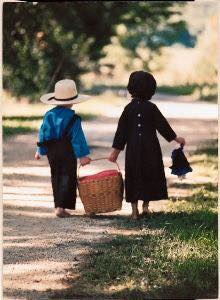

Amish
roots stretch back to sixteenth-century Europe. Impatient with the
pace of the Protestant Reformation, youthful reformers in Zurich,
Switzerland, outraged religious authorities by baptizing each other
in January 1525. The rebaptism of adults was then a crime punishable
by death. Baptism, in the dissidents' view, was only meaningful for
adults who had made a voluntary confession of faith. Because they
were already baptized as infants in the Catholic Church, the radicals
were dubbed Anabaptists, or rebaptizers, by their opponents.
Anabaptism, also known as the Radical Reformation, spread through the
Cantons of Switzerland, Germany, and the Netherlands.
The
rapid spread of Anabaptist groups threatened civil and religious
authorities. Anabaptist hunters soon stalked the Reformers. The first
martyr was drowned in 1527. Over the next few decades, thousands of
Anabaptists burned at the stake, drowned in rivers, starved in
prisons, or lost their heads to the executioner's sword. The
1,200-page Martyrs Mirror, first published in Dutch in 1660 and later
in German and English, records the carnage. Many Amish have a German
edition of the Martyrs Mirror in their homes today.
The
Swiss Anabaptists sought to follow the ways of Jesus in daily life,
loving their enemies, forgiving insults, and turning the other cheek.
Some Anabaptist groups resorted to violence, but many repudiated
force and resolved to live peaceably even with adversaries. The
flames of execution tested their faith in the power of suffering
love, and although some recanted, many died for their faith. Harsh
persecution pushed many Anabaptists underground and into rural
hideaways. Swiss Anabaptism took root in rural soil. The sting of
persecution, however, divided the church and the larger society in
Anabaptist minds. The Anabaptists believed that the kingdoms of this
world anchored on the use of coercion clashed with the peaceable
kingdom of God.
By
1660 some Swiss Anabaptists had migrated north to the Alsace region
of present-day France, which borders southwestern Germany. The Amish
came into the picture in 1693 when Swiss and South German Anabaptists
split into two streams: Amish and Mennonite. Jakob Ammann, an elder
of the Alsatian church, sought to revitalize the Anabaptist movement
in 1693. He proposed holding communion twice a year rather than the
typical Swiss practice of once a year. He argued that Anabaptist
Christians in obedience to Christ should wash each others' feet in
the communion service. To promote doctrinal purity and spiritual
discipline Ammann forbade fashionable dress and the trimming of
beards, and he administered a strict discipline in his congregations.
Appealing to New Testament teachings, Ammann advocated the shunning
of excommunicated members. Ammann's followers, eventually called
Amish, soon became another sect in the Anabaptist family.
SIGNIFICANT
IMMIGRATION WAVES
Searching
for political stability and religious freedom, the Amish came to
North America in two waves—in the mid-1700s and again in the first
half of the 1800s. Their first settlements were in southeastern
Pennsylvania. Eventually they followed the frontier to other counties
in Pennsylvania, then to Ohio, Indiana, and to other Midwestern
states. Today Amish settlements are primarily located in the
mid-Atlantic and the Midwest regions of the United States. Very few
Amish live west of the Mississippi or in the deep south. In Europe,
the last Amish congregation dissolved about 1937.
SETTLEMENT
PATTERNS
Flowing
with the rising tide of industrialization in the late nineteenth
century, some clusters of Amish formed more progressive
Amish-Mennonite churches. The more conservative guardians of the
heritage became known as the Old Order Amish. In the twentieth
century some Old Order Amish, hankering again after modern
conveniences, formed congregations of New Order Amish in the 1960s.
The small numbers of New Order Amish groups sometimes permit their
members to install phones in their homes, use electricity from public
utilities, and use tractors in their fields.
At
the turn of the twentieth century the Old Order Amish numbered about
5,000 in North America. Now scattered across 22 states and Ontario
they number about 150,000 children and adults. Nearly three quarters
live in Ohio, Pennsylvania, and Indiana. Other sizeable communities
are in Iowa, Michigan, Missouri, New York, and Wisconsin. A loose
federation of some 900 congregations, the Amish function without a
national organization or an annual convention. Local church
districts—congregations of 25 to 35 families—shape the heart of
Amish life.
Acculturation
and Assimilation
The
Amish have been able to maintain a distinctive ethnic subculture by
successfully resisting acculturation and assimilation. The Amish try
to maintain cultural customs that preserve their identity. They have
resisted assimilation into American culture by emphasizing separation
from the world, rejecting higher education, selectively using
technology, and restricting interaction with outsiders.

TRADITIONS,
CUSTOMS, AND BELIEFS
The
word Amish evokes images of buggies and lanterns. At first glance
Amish groupings across North America appear pressed from the same
cultural mold. A deeper look reveals many differences among Amish
groups. Some affiliations forbid milking machines while others depend
on them. Mechanical hay balers widely used in some areas are taboo in
others. Prescribed buggy tops are gray or black in many affiliations
but other groups have white or yellow tops. Buttons on clothing are
banished in many groups, but acceptable in others. The dead are
embalmed in one settlement but not in another. Some bishops permit
telephones in small shops, but others do not. Artificial insemination
of livestock is acceptable in one district but not in another. In
some communities virtually all the men are farmers, but in others
many adults work in small shops and cottage industries. In still
other settlements Amish persons work in rural factories operated by
non-Amish persons. Practices vary between church districts even
within the same settlement. Diversity thrives behind the front stage
of Amish life.
Several
distinctive badges of ethnic identity unite the Old Order Amish
across North America: horse-and-buggy transportation; the use of
horses and mules for field work; plain dress in many variations; a
beard and shaven upper lip for men; a prayer cap for women; the
Pennsylvania German dialect; worship in homes; eighth-grade,
parochial schooling; the rejection of electricity from public utility
lines; and taboos on the ownership of televisions and computers.
These symbols of solidarity circumscribe the Amish world and bridle
the forces of assimilation.
Amish
life pivots on Gelassenheit (pronounced Ge-las-en-hite), the
cornerstone of Amish values. Roughly translated, this German word
means submission, yielding to a higher authority. In practice it
entails self-surrender, resignation to God's will, yielding to
others, self-denial, contentment, and a quiet spirit. The religious
meaning of Gelassenheit expresses itself in a quiet and reserved
personality and places the needs of others above self. It nurtures a
subdued self, gentle handshakes, lower voices, slower strides, a life
etched with modesty and reserve. Children learn the essence of
Gelassenheit in a favorite verse: "I must be a Christian child,
/ Gentle, patient, meek, and mild, / Must be honest, simple, true, /
I must cheerfully obey, / Giving up my will and way."
Another
favorite saying explains that JOY means Jesus first, Yourself last,
and Others in between. As the cornerstone of Amish culture,
Gelassenheit collides with the bold, assertive individualism of
modern life that seeks and rewards personal achievement,
self-fulfillment, and individual recognition at every turn.
The
spirit of Gelassenheit expresses itself in obedience, humility, and
simplicity. To Amish thinking, obedience to the will of God is the
cardinal religious value. Disobedience is dangerous. Unconfessed it
leads to eternal separation. Submission to authority at all levels
creates an orderly community. Children learn to obey at an early age.
Disobedience is nipped in the bud. Students obey teachers without
question. Adults yield to the regulations of the church. Among
elders, ministers concede to bishops, who obey the Lord.
Humility
is coupled with obedience in Amish life. Pride, a religious term for
unbridled individualism, threatens the welfare of an orderly
community. Amish teachers also remind students that the middle letter
of pride is I. Proud individuals display the spirit of arrogance, not
Gelassenheit. They are pushy, bold, and forward. What non-Amish
consider proper credit for one's accomplishments the Amish view as
the hankerings of a vain spirit. The Amish contend that pride
disturbs the equality and tranquility of an orderly community. The
humble person freely gives of self in the service of community
without seeking recognition.
Simplicity
is also esteemed in Amish life. Simplicity in clothing, household
decor, architecture, and worship nurtures equality and orderliness.
Fancy and gaudy decorations lead to pride. Luxury and convenience
cultivate vanity. The tools of self-adornment—make-up, jewelry,
wrist watches, and wedding rings—are taboo and viewed as signs of
pride.
AMISH
SURVIVAL
The
Amish do not actively evangelize. They do welcome outsiders, but few
make the cultural leap. Membership in some settlements doubles about
every 20 years. Their growth is fueled by a robust birth rate that
averages seven children per family. The defection rate varies by
settlement, but is usually less than 20 percent. Thus, six out of
seven children, on the average, remain Amish.
Beyond
biological reproduction, a dual strategy of resistance and compromise
has enabled the Amish to flourish in the modern world. They have
resisted acculturation by constructing social fences around their
community. Core values are translated into visible symbols of
identity. Badges of ethnicity—horse, buggy, lantern, dialect, and
dress—draw sharp contours between Amish and modern life.
The
Amish resist the forces of modernization in other ways. Cultural ties
to the outside world are curbed by speaking the dialect, marrying
within the group, spurning television, prohibiting higher education,
and limiting social interaction with outsiders. Parochial schools
insulate Amish youth from the contaminating influence of worldly
peers. Moreover, ethnic schools limit exposure to threatening ideas.
From birth to death, members are embedded in a web of ethnicity.
These cultural defenses fortify Amish identity and help abate the
lure of modernity.
The
temptations of the outside world, however, have always been a factor
in Amish life. Instead of forbidding contact outright, the Amish
tolerate the custom of rumschpringen, or running around. This custom
allows Amish teenagers and young adults to flirt for a few years with
such temptations as drinking, dating, and driving cars before they
accept baptism and assume their adult responsibilities within the
Amish community. Though such behavior is, for the most part,
relatively mild, in recent years it has included more extreme
activities. In 1998, for example, two Amish men in Lancaster County
were charged with selling cocaine to other young people in their
community. And in 1999, as many as 40 Amish teenagers turned violent
after a drinking spree and seriously vandalized a Amish farmstead.
While community elders express increasing concern about such events,
they stress that most youthful behavior does not exceed reasonable
bounds.
The
survival strategy of the Amish has also involved cultural
compromises. The Amish are not a calcified relic of bygone days, for
they change continually. Their willingness to compromise often
results in odd mixtures of tradition and progress. Tractors may be
used at Amish barns but not in fields. Horses and mules pull modern
farm machinery in some settlements. Twelve-volt electricity from
batteries is acceptable but not when it comes from public utility
lines. Hydraulic and air pressure are used instead of electricity to
operate modern machines in many Amish carpentry and mechanical shops.
Members frequently ride in cars or vans, but are not permitted to
drive them. Telephones, found by farm lanes and shops, are missing
from Amish homes. Modern gas appliances fill Amish kitchens in some
states and lanterns illuminate modern bathrooms in some Amish homes.
These
riddles of Amish life often baffle and, indeed, appear downright
silly to outsiders. In reality, however, they reflect delicate
bargains that the Amish have struck between their desire to maintain
tradition while enjoying the fruits of progress. The Amish are
willing to change but not at the expense of communal values and
ethnic identity. They use modern technology but not when it disrupts
family and community stability.
Viewed
within the context of Amish history, the compromises are reasonable
ways of achieving community goals. Hardly foolish contradictions,
they preserve core values while permitting selective modernization.
They bolster Amish identity while reaping many benefits of modern
life. Such flexibility boosts the economic vitality of the community
and also retains the allegiance of Amish youth.
CUISINE
Food
preferences among the Amish vary somewhat from state to state.
Breakfast fare for many families includes eggs, fried potatoes,
toast, and in some communities, commercial cereals such as
Corn-flakes and Cheerios. Typical breakfast foods in Pennsylvania
also include shoofly pie, which is sometimes dipped in or covered
with coffee or milk, stewed crackers in warm milk, mush made from
corn meal, and sausage. Puddings and scrapple are also breakfast
favorites. The puddings consist of ground liver, heart, and kidneys
from pork and beef. These basic ingredients are also combined with
flour and corn meal to produce scrapple.
For
farm families the mid-day dinner is usually the largest meal of the
day. Noontime dinners and evening suppers often include beef or
chicken dishes, and vegetables in season from the family garden, such
as peas, corn, green beans, lima beans, and carrots. Mashed potatoes
covered with beef gravy, noodles with brown butter, chicken potpie,
and sauerkraut are regional favorites. For side dishes and deserts
there are applesauce, corn starch pudding, tapioca, and fruit pies in
season, such as apple, rhubarb, pumpkin, and snitz pies made with
dried apples. Potato soup and chicken-corn-noodle soup are
commonplace. In summer months cold fruit soups consisting of
strawberries, raspberries, or blueberries added to milk and bread
cubes appear on Amish tables. Meadow tea, homemade root beer, and
instant drink mixes are used in the summer.
Food
preservation and preparation for large families and sizeable
gatherings is an enormous undertaking. Although food lies beyond the
reach of religious regulations, each community has a traditional menu
that is typically served at large meals following church services,
weddings, and funerals. Host families often bake three dozen pies for
the noontime meal following the biweekly church service. Quantities
of canned food vary by family size and preference but it is not
uncommon for a family to can 150 quarts of apple sauce, 100 quarts of
peaches, 60 quarts of pears, 50 quarts of grape juice, and 50 quarts
of pizza sauce.
More
and more food is purchased from stores, sometimes operated by the
Amish themselves. In a more progressive settlement one Amishwoman
estimates that only half of the families bake their own bread. The
growing use of instant pudding, instant drinks, snack foods, and
canned soups reflects growing time constraints. The use of commercial
food rises as families leave the farm and especially as women enter
entrepreneurial roles.
TRADITIONAL
COSTUMES
The
Amish church prescribes dress regulations for its members but the
unwritten standards vary considerably by settlement. Men are expected
to wear a wide brim hat and a vest when they appear in public. In
winter months and at church services they wear a black suit coat
which is typically fastened with hooks and eyes rather than with
buttons. Men use suspenders instead of belts.
Amish
women are expected to wear a prayer covering and a bonnet when they
appear in public settings. Most women wear a cape over their dresses
as well as an apron. The three parts of the dress are often fastened
together with straight pins. Various colors, including green, brown,
blue, and lavender, are permitted for men's shirts and women's
dresses, but designs and figures in the material are taboo. Although
young girls do not wear a prayer covering, Amish children are
typically dressed similar to their parents.
HOLIDAYS
Sharing
some national holidays with non-Amish neighbors and adding others of
their own, the Amish calendar underscores both their participation in
and separation from the larger world. As conscientious objectors,
they have little enthusiasm for patriotic days with a military flair.
Memorial Day, Veterans Day, and the Fourth of July are barely
noticed. Labor Day stirs little interest. The witches and goblins of
Halloween run contrary to Amish spirits: pumpkins may be displayed in
some settlements, but without cut faces. And Martin Luther King,
Jr.'s birthday slips by unnoticed in many rural enclaves.
Amish
holidays earmark the rhythm of the seasons and religious
celebrations. A day for prayer and fasting precedes the October
communion service in some communities. Fall weddings provide ample
holidays of another sort. Amish without wedding invitations celebrate
Thanksgiving Day with turkey dinners and family gatherings. New
Year's Day is a quiet time for family gatherings. In many communities
a second day is added to the celebrations of Christmas, Easter, and
Pentecost. The regular holiday, a sacred time, flows with quiet
family activities. The following day, or second Christmas, Easter
Monday, and Pentecost Monday, provides time for recreation, visiting,
and sometimes shopping. Ascension day, the day prior to Pentecost, is
a holiday for visiting, fishing, and other forms of recreation.
Christmas
and Easter festivities are spared from commercial trappings. Families
exchange Christmas cards and gifts. Some presents are homemade crafts
and practical gifts, but are increasingly store bought. Homes are
decorated with greens but Christmas trees, stockings, special lights,
Santa Claus, and mistletoe are missing. Although eggs are sometimes
painted and children may be given a basket of candy, Easter bunnies
do not visit Amish homes. These sacred holidays revolve around
religious customs, family gatherings, and quiet festivities rather
than commercial trinkets and the sounds of worldly hubbub. Birthdays
are celebrated at home and school in quiet, pleasant ways, with cakes
and gifts. Parents often share a special snack of cookies or
popsicles with school friends to honor a child's birthday.
HEALTH
ISSUES
Contrary
to popular misconceptions the Amish use modern medical services to
some extent. Lacking professionals within their ranks, they rely on
the services of dentists, optometrists, nurses, and physicians in
local health centers, clinics, and hospitals. They cite no biblical
injunctions against modern health care nor the latest medicine, but
they do believe that God is the ultimate healer. Despite the absence
of religious taboos on health care, Amish practices differ from
prevailing patterns.
The
Amish generally do not subscribe to commercial health insurance. Some
communities have organized church aid plans for families with special
medical costs. In other settlements special offerings are collected
for members who are hit with catastrophic medical bills. The Amish
are unlikely to seek medical attention for minor aches or illnesses
and are more apt to follow folk remedies and drink herbal teas.
Although they do not object to surgery or other forms of high-tech
treatment they rarely employ heroic life-saving interventions.
In
addition to home remedies, church members often seek healing outside
orthodox medical circles. The search for natural healing leads them
to vitamins, homeopathic remedies, health foods, reflexologists,
chiropractors, and the services of specialized clinics in faraway
places. These cultural habits are shaped by many factors:
conservative rural values, a preference for natural antidotes, a lack
of information, a sense of awkwardness in high-tech settings,
difficulties accessing health care, and a willingness to suffer and
lean on the providence of God.
Birthing
practices vary in different settlements. In some communities most
babies are born at home under the supervision of trained non-Amish
midwives. In other settlements most children are born in hospitals or
at local birthing clinics. Children can attend Amish schools without
immunizations. Some parents follow the advice of family doctors or
trained midwives and immunize their children, but many do not. Lax
immunization is often due to cost, distance, misinformation, or lack
of interest. Occasional outbreaks of German measles, whooping cough,
polio, and other contagious diseases prompt public health campaigns
to immunize Amish children. Amish elders usually encourage their
people to cooperate with such efforts. In recent years various health
providers have made special efforts to immunize Amish children.
Marriages
within stable geographical communities and the influx of few converts
restricts the genetic pool of Amish society. Marriages sometimes
occur between second cousins. Such intermarriage does not always
produce medical problems. When unique recessive traits are common in
a closed community certain diseases simply are more likely to occur.
On the other hand, a restricted gene pool may offer protection from
other hereditary diseases.
A
special type of dwarfism accompanied by other congenital problems
occurs at an exceptionally high rate in some settlements. Higher
rates of deafness have also been found. In the late 1980s, Dr. Holmes
Morton identified glutaric aciduria in the Lancaster, Pennsylvania,
Amish community. Unrecognized and untreatable before, the disease is
a biochemical disorder with symptoms similar to cerebral palsy.
Approximately one in every 200 Amish infants inherits the disease. By
1991, Dr. Morton had organized a special clinic that tested some 70
percent of Amish infants and treated those diagnosed with the disease
in the Lancaster settlement.
Another
condition, Crigler-Najjar syndrome, occurs more frequently among the
Amish and the Mennonites than in the general population. The
condition is difficult to treat, and can result in brain damage and
early death. The Amish have worked eagerly with researchers who are
studying a new type of gene therapy for the treatment of this
disease. In 1989, the Amish community united, barnraising style, to
build the Clinic for Special Children in Strasburg, Pennsylvania, a
facility that treats Crigler-Najjar patients.
Language
The
Amish speak English, German, and a dialect known as Pennsylvania
German or Pennsylvania Dutch. The dialect is the Amish native tongue
and should not be confused with the Dutch language of the
Netherlands. Originally a German dialect, Pennsylvania Dutch was
spoken by Germanic settlers in southeastern Pennsylvania. The folk
pronunciation of the word German, Deutsche, gradually became Dutch in
English, and eventually the dialect became known as Pennsylvania
Dutch. Even the Amish who live outside of Pennsylvania speak the
Pennsylvania German dialect. In Amish culture, the dialect is used
mainly as a form of oral communication: it is the language of work,
family, friendship, play, and intimacy.
Young
children live in the world of the dialect until they learn English in
the Amish school. Students learn to read, write, and speak English
from their Amish teachers, who learned it from their Amish teachers.
But the dialect prevails in friendly banter on the playground. By the
end of the eighth grade, young Amish have developed basic competence
in English although it may be spoken with an accent. Adults are able
to communicate in fluent English with their non-Amish neighbors. When
talking among themselves, the Amish sometimes mix English words with
the dialect, especially when discussing technical issues. Letters are
often written in English, with salutations and occasional phrases in
the dialect. Competence in English varies directly with occupational
roles and frequency of interaction with English speakers. Ministers
are often the ones who are best able to read German. Idioms of the
dialect are frequently mixed with German in Amish sacred writings.
Although children study formal German in school they do not speak it
on a regular basis.
GREETINGS
AND OTHER POPULAR EXPRESSIONS
Common
Pennsylvania Dutch greetings and other expressions include: Gude
Mariye— Good morning; Gut-n-Owed— Good evening; Wie geht's?—
How are you?; En frehlicher Grischtdsaag— a Merry Christmas;
Frehlich Neiyaahr— Happy New Year; kumm ball widder— come soon
again. When inviting others to gather around a table to eat, a host
might say Kumm esse.
Family
and Community Dynamics
The
immediate family, the extended family, and the church district form
the building blocks of Amish society. Amish parents typically raise
about seven children, but ten or more children is not uncommon. About
50 percent of the population is under 18 years of age. A person will
often have more than 75 first cousins and a typical grandmother will
count more than 35 grandchildren. Members of the extended family
often live nearby, across the field, down the lane, or beyond the
hill. Youth grow up in this thick network of family relations where
one is rarely alone, always embedded in a caring community in time of
need and disaster. The elderly retire at home, usually in a small
apartment built onto the main house of a homestead. Because the Amish
reject government aid, there are virtually no families that receive
public assistance. The community provides a supportive social hammock
from cradle to grave.
SOCIAL
ORGANIZATION
A
church district comprises 25 to 35 families and is the basic social
and religious unit beyond the family. Roads and streams mark the
boundaries of districts. Members are required to participate in the
geographic district in which they live. A district's geographic size
varies with the density of the Amish population. As districts expand,
they divide.
A
bishop, two preachers, and a deacon share leadership responsibilities
in each district without formal pay or education. The bishop, as
spiritual elder, officiates at baptisms, weddings, communions,
funerals, ordinations, and membership meetings. The church district
is church, club, family, and precinct all wrapped up in a
neighborhood parish. Periodic meetings of ordained leaders link the
districts of a settlement into a loose federation.
The
social architecture of Amish society exhibits distinctive features.
Leisure, work, education, play, worship, and friendship revolve
around the immediate neighborhood. In some settlements, Amish babies
are born in hospitals, but they are also born at home or in local
birthing centers. Weddings and funerals occur at home. There are
frequent trips to other settlements or even out of state to visit
relatives and friends. But for the most part the Amish world pivots
on local turf. From home-canned food to homemade haircuts, things are
likely to be done near home. Social relationships are multi-bonded.
The same people frequently work, play, and worship together.
Amish
society is remarkably informal and the tentacles of bureaucracy are
sparse. There is no centralized national office, symbolic national
figurehead, or institutional headquarters. Apart from schools, a
publishing operation, and regional historical libraries, formal
institutions simply do not exist. A loosely organized national
committee handles relations with the federal government for all the
settlements. Regional committees funnel the flow of Amish life for
schools, mutual aid, and historical libraries, but bureaucracy as we
know it in the modern world is simply absent.
The
conventional marks of modern status (education, income, occupation,
and consumer goods) are missing and make Amish society relatively
homogeneous. The agrarian heritage places everyone on common footing.
The recent rise of cottage industries in some settlements and factory
work in others threatens to disturb the social equality of bygone
years, but the range of occupations and social differences remains
relatively small. Common costume, horse and buggy travel, an
eighth-grade education, and equal-size tombstones embody the virtues
of social equality.
The
practice of mutual aid also distinguishes Amish society. Although the
Amish own private property, like other Anabaptists they have long
emphasized mutual aid as a Christian duty in the face of disaster and
special need. Mutual aid goes beyond barn raisings. Harvesting,
quilting, birthing, marriages, and funerals require the help of many
hands. The habits of care encompass all sorts of needs triggered by
drought, disease, death, injury, bankruptcy, and medical emergency.
GENDER
ROLES
Amish
society is patriarchal. Although school teachers are generally women,
men assume the helm of most leadership roles. Women can nominate men
to serve in ministerial roles but they themselves are excluded from
formal church roles; however, they can vote in church business
meetings. Some women feel that since the men make the rules, modern
equipment is permitted more readily in barns and shops than in homes.
In recent years some women have become entrepreneurs who operate
small quilt, craft, and food stores.
Although
husband and wife preside over distinct spheres of domestic life, many
tasks are shared. A wife may ask her husband to assist in the garden
and he may ask her to help in the barn or fields. The isolated
housewife is rarely found in Amish society. The husband holds
spiritual authority in the home but spouses have considerable freedom
within their distinctive spheres.
SOCIAL
GATHERINGS
Various
social gatherings bring members together for times of fellowship and
fun beyond biweekly worship. Young people gather in homes for Sunday
evening singing. Married couples sometimes gather with old friends to
sing for shut-ins and the elderly in their homes. Work frolics blend
work and play together in Amish life. Parents gather for preschool
frolics to ready schools for September classes. Endof-school picnics
bring parents and students together for an afternoon of food and
games.
Quilting
bees and barn raisings mix goodwill, levity, and hard work for young
and old alike. Other moments of collective work (cleaning up after a
fire, plowing for an ill neighbor, canning for a sick mother,
threshing wheat, and filling a silo) involve neighbors and extended
families in episodes of charity, sweat, and fun. Adult sisters,
sometimes numbering as many as five or six, often gather for a
sisters day, which blends laughter with cleaning, quilting, canning,
or gardening.
Public
auctions of farm equipment are often held in February and March and
attract crowds in preparation for springtime farming. Besides
opportunities to bid on equipment, the day-long auctions offer ample
time for farm talk and friendly fun. Games of cornerball in a nearby
field or barnyard often compete with the drama of the auction.
Household auctions and horse sales provide other times to socialize.
Family gatherings at religious holidays and summer family reunions
link members into familial networks. Single women sometimes gather at
a cabin or a home for a weekend of fun. Special meetings of persons
with unique interests, often called reunions, are on the rise and
attract Amish from many states: harnessmakers, cabinetmakers,
woodworkers, blacksmiths, businesswomen, teachers, the disabled, and
the like. The disabled have gathered annually for a number of years.
Among
youth, seasonal athletics are common: softball, sledding, skating,
hockey, and swimming. Volleyball is a widespread favorite. Fishing
and hunting for small game are preferred sports on farms and
woodlands. In recent years some Amishmen have purchased hunting
cabins in the mountains where they hunt white-tailed deer. Deep-sea
fishing trips are common summertime jaunts for men in Pennsylvania.
Others prefer camping and canoeing. Pitching quoits is common at
family reunions and picnics.
Leisure
and pleasure have long been suspect in Amish life. Idleness is viewed
as the devil's workshop. But the rise of cottage industries and the
availability of ready cash has brought more recreational activities.
Amish recreation is group oriented and tilted more toward nature than
toward taboo commercial entertainment. The Amish rarely take
vacations but they do take trips to other settlements and may stop at
scenic sites. Some couples travel to Florida for several weeks in the
winter and live in an Amish village in Sarasota populated by winter
travelers from settlements in several states. Trips to distant sites
in search of special medical care sometimes include scenic tours.
Although some Amish travel by train or bus, chartered vans are by far
the most popular mode. Traveling together with family, friends, and
extended kin these mobile groups bond and build community life.
INTERACTION
WITH OTHERS
Amish
culture and religion stresses separation from the world. Galvanized
by European persecution and sanctioned by scripture, the Amish divide
the social world into two pathways: the straight, narrow way to life,
and the broad, easy road to destruction. Amish life embodies the
narrow way of self-denial. The larger social world symbolizes the
broad road of vanity and vice. The term world, in Amish thinking,
refers to the outside society and its values, vices, practices, and
institutions. Media reports of greed, fraud, scandal, drugs,
violence, divorce, and abuse confirm that the world teems with
abomination.
The
gulf between church and world, imprinted in Amish minds by European
persecution, guides practical decisions. Products and practices that
might undermine community life, such as high school, cars, cameras,
television, and self-propelled farm machinery, are tagged worldly.
Not all new products receive this label, only those that threaten
community values. Definitions of worldliness vary within and between
Amish settlements, yielding a complicated maze of practices. Baffling
to outsiders, these lines of faithfulness maintain inter-group
boundaries and also preserve the cultural purity of the church.
WEDDINGS
The
wedding season is a festive time in Amish life. Coming on the heels
of the harvest, weddings are typically held on Tuesdays and Thursdays
from late October through early December. The larger communities may
have as many as 150 weddings in one season. Fifteen weddings may be
scattered across the settlement on the same day. Typically staged in
the home of the bride, these joyous events may involve upwards of 350
guests, two meals, singing, snacks, festivities, and a three-hour
service. The specific practices vary from settlement to settlement.
Young
persons typically marry in their early twenties. A couple may date
for one to two years before announcing their engagement. Bishops will
only marry members of the church. The church does not arrange
marriages but it does place its blessing on the pair through an old
ritual. Prior to the wedding, the groom takes a letter signed by
church elders to the bride's deacon testifying to the groom's good
standing in his home district. The bride's deacon then meets with her
to verify the marriage plans.
The
wedding day is an enormous undertaking for the bride's family and for
the relatives and friends who assist with preparations. Efforts to
clean up the property, paint rooms, fix furniture, pull weeds, and
pave driveways, among other things, begin weeks in advance. The
logistics of preparing meals and snacks for several hundred guests
are taxing. According to custom, the day before the wedding the groom
decapitates several dozen chickens. The noontime wedding menu
includes chicken roast—chicken mixed with bread filling, mashed
potatoes, gravy, creamed celery, pepper cabbage, and other items.
Desserts include pears, peaches, puddings, dozens of pies, and
hundreds of cookies and doughnuts.
The
three-hour service—without flowers, rings, solos, or instrumental
music—is similar to an Amish worship service. The wedding includes
congregational singing, prayers, wedding vows, and two sermons. Four
single friends serve the bride and groom as attendants: no one is
designated maid of honor or best man. Amish brides typically make
their own wedding dresses from blue or purple material crafted in
traditional styles. In addition to the groom's new but customary
black coat and vest, he and his attendants often wear small black bow
ties.
Several
seatings and games, snacks, and singing follow the noon meal. Young
people are paired off somewhat randomly for the singing. Following
the evening meal another more lively singing takes place in which
couples who are dating pair off— arousing considerable interest
because this may be their first public appearance. Festivities may
continue until nearly midnight as guests gradually leave. Some
guests, invited to several weddings on the same day, may rotate
between them.
Newly
married couples usually set up housekeeping in the spring after their
wedding. Until then the groom may live at the bride's home or
continue to live with his parents. Couples do not take a traditional
honeymoon, but visit relatives on weekends during the winter months.
Several newlywed couples may visit together, sometimes staying
overnight at the home of close relatives. During these visits, family
and friends present gifts to the newlyweds to add to the bride's
dowry, which often consists of furniture. Young men begin growing a
beard, the functional equivalent of a wedding ring, soon after their
marriage. They are expected to have a "full stand" by the
springtime communion.
FUNERALS
With
the elderly living at home, the gradual loss of health prepares
family members for the final passage. Accompanied by quiet grief,
death comes gracefully, the final benediction to a good life and
entry into the bliss of eternity. Although funeral practices vary
from community to community, the preparations reflect core Amish
values, as family and friends yield to eternal verities.
The community springs into action at the word of a death. Family and friends in the local church district assume barn and household chores, freeing the immediate family. Well-established funeral rituals unburden the family from worrisome choices. Three couples are appointed to extend invitations and supervise funeral arrangements: food preparation, seating arrangements, and the coordination of a large number of horses and carriages.
In the Lancaster, Pennsylvania, settlement a non-Amish undertaker moves the body to a funeral home for embalming. The body, without cosmetic improvements, returns to the home in a simple, hardwood coffin within a day. Family members of the same sex dress the body in white. White garments symbolize the final passage into a new and better eternal life. Tailoring the white clothes prior to death helps to prepare the family for the season of grief. Women often wear the white cape and apron worn at their wedding.
Friends
and relatives visit the family and view the body in a room on the
first floor of the home for two days prior to the funeral. Meanwhile
community members dig the grave by hand in a nearby family cemetery
as others oversee the daily chores of the bereaved. Several hundred
guests attend the funeral in a barn or home typically on the morning
of the third day after death. During the simple hour-anda-half-long
service, ministers read hymns and scriptures, offer prayers, and
preach a sermon. There are no flowers, burial gowns, burial tents,
limousines, or sculpted monuments.
The
hearse, a large, black carriage pulled by horses, leads a long
procession of other carriages to the burial ground on the edge of a
farm. After a brief viewing and graveside service, pallbearers lower
the coffin and shovel soil into the grave as the bishop reads a hymn.
Small, equal-sized tombstones mark the place of the deceased in the
community of equality. Close friends and family members then return
to the home for a meal prepared by members of the local congregation.
Bereaved women, especially close relatives, may signal their mourning
by wearing a black dress in public settings for as long as a year. A
painful separation laced with grief, death is nevertheless received
gracefully as the ultimate surrender to God's higher ways.
EDUCATION
The
Amish supported public education when it revolved around one-room
schools in the first half of the twentieth century. Under local
control, the one-room rural schools posed little threat to Amish
values. The massive consolidation of public schools and growing
pressure to attend high school sparked clashes between the Amish and
officials in several states in the middle of the twentieth century.
Confrontations in several other states led to arrests and brief
stints in jail. After legal skirmishes in several states, the U.S.
Supreme Court gave its blessing to the eighth-grade Amish school
system in 1972, stating that "there can be no assumption that
today's majority is 'right' and the Amish and others are 'wrong. "'
The court concluded that "a way of life that is odd or even
erratic but interferes with no rights or interests of others is not
to be condemned because it is different."
Today
the Amish operate more than 850 parochial schools for some 24,000
Amish children. Many of the schools have one room with 25 to 35
pupils and one teacher who is responsible for teaching all eight
grades. A few Amish children attend rural public schools in some
states but the vast majority go to parochial schools operated by the
Amish.
A
scripture reading and prayer opens each school day, but religion is
not formally taught in the school. The curriculum includes reading,
arithmetic, spelling, grammar, penmanship, history, and geography.
Both English and German are taught. Parents want children to learn
German to enhance their ability to read religious writings, many of
which are written in formal German. Science and sex education are
missing in the curriculum as are the other typical trappings of
public schools: sports, dances, cafeterias, clubs, bands, choruses,
computers, television, guidance counselors, principals, strikes, and
college recruiters.
A
local board of three to five fathers organizes the school, hires a
teacher, approves curriculum, oversees the budget, and supervises
maintenance. Teachers receive about $25 to $35 per day. The cost per
child is roughly $250 per year, nearly 16 times lower than many
public schools where per pupil costs often top $4,000. Amish parents
pay public school taxes and taxes for their own school.
Schools
play a critical role in the preservation of Amish culture. They not
only reinforce Amish values, but also shield youth from contaminating
ideas. Moreover, schools restrict friendships with non-Amish peers
and impede the flow of Amish youth into higher education and
professional life. Amish schools promote practical skills to prepare
their graduates for success in Amish society. Some selective testing
indicates that Amish pupils compare favorably with rural peers in
public schools on standardized tests of basic skills.
Amish
teachers, trained in Amish schools, are not required to be certified
in most states. Often the brightest and best of Amish scholars, they
return to the classroom in their late teens and early twenties to
teach. Amish school directors select them for their ability to teach
and their commitment to Amish values. Frequently single women, they
typically drop their occupation if wed. Periodic meetings with other
teachers, a monthly teachers' magazine, and ample common sense
prepare them for the task of teaching 30 students in eight grades.
With three or four pupils per grade, teachers often teach two grades
at a time. Pupils in other classes ponder assignments or listen to
previews of next year's lessons or hear reviews of past work.
Classrooms exhibit a distinct sense of order amidst a beehive of
activity. Hands raise to ask permission or clarify instructions as
the teacher moves from cluster to cluster teaching new material every
ten or 15 minutes. Some textbooks are recycled from public schools
while others are produced by Amish publishers. Students receive a
remarkable amount of personal attention despite the teacher's
responsibility for eight grades. The ethos of the classroom accents
cooperative activity, obedience, respect, diligence, kindness, and
the natural world. Despite the emphasis on order, playful pranks and
giggles are commonplace. Schoolyard play in daily recesses often
involves softball or other homespun games.
Amish
schools exhibit a social continuity rarely found in public education.
With many families sending several children to a school, teachers may
relate to as few as a dozen households. Teachers know parents
personally and special circumstances surrounding each child. In some
cases, children have the same teacher for all eight grades. Indeed,
all the children from a family may have the same teacher. Amish
schools are unquestionably provincial by modern standards. Yet in a
humane fashion they ably prepare Amish youth for meaningful lives in
Amish society.
Religion
At
first glance the Amish appear quite religious. Yet a deeper
inspection reveals no church buildings, sacred symbols, or formal
religious education even in Amish schools. Unlike most modern
religions, religious meanings pervade all aspects of Amish lives.
Religion is practiced, not debated. Silent prayers before and after
meals embroider each day with reverence. The Amish way of living and
being requires neither heady talk nor formal theology.
The
Ordnung, a religious blueprint for expected behavior, regulates
private, public, and ceremonial behavior. Unwritten in most
settlements, the Ordnung is passed on by oral tradition. A body of
understandings that defines Amish ways, the Ordnung marks expected
Amish behavior: wearing a beard without a mustache; using a buggy;
and speaking the dialect. It also specifies taboos: divorce; filing a
lawsuit; wearing jewelry; owning a car; and attending college. The
understandings evolve over the years and are updated as the church
faces new issues: embryo transplants in cattle; using computers and
facsimile machines; and working in factories. Core understandings,
such as wearing a beard and not owning a car, span all Old Order
Amish settlements but the finer points of the Ordnung vary
considerably from settlement to settlement.
Although
ordained leaders update the Ordnung in periodic meetings, each bishop
interprets it for his local congregation. Thus, dress styles and the
use of telephones and battery-powered appliances may vary by church
district. Once embedded in the Ordnung and established as tradition,
the understandings rarely change. As new issues face the church,
leaders identify those which may be detrimental to community life.
Non-threatening changes such as weed-whackers and instant coffee may
be overlooked and gradually slip into Amish life. Battery-powered
video cameras, which might lead to other video entanglements with the
outside world, would surely be forbidden.
Children
learn the ways of the Ordnung by observing adults. The Ordnung
defines the way things are in a child's mind. Teenagers, free from
the supervision of the church, sometimes flirt with worldly ways and
flaunt the Ordnung. At baptism, however, young adults between the
ages of 16 and 22 declare their Christian faith and vow to uphold the
Ordnung for the rest of their life. Those who break their promise
face excommunication and shunning. Those choosing not to be baptized
may gradually drift away from the community but are welcome to return
to their families without the stigma of shunning.
WORSHIP
SERVICES
Worship
services held in Amish homes reaffirm the moral order of Amish life.
Church districts hold services every other Sunday. A group of 200 or
more, including neighbors and relatives who have an "off
Sunday," gather for worship. They meet in a farmhouse, the
basement of a newer home, or in a shed or barn. A fellowship meal at
noon and informal visiting follow the three-hour morning service.
The
plain and simple but unwritten liturgy revolves around congregational
singing and two sermons. Without the aid of organs, offerings,
candles, crosses, robes, or flowers, members yield themselves to God
in the spirit of humility. The congregation sings from the Ausbund, a
hymnal of German songs without musical notations that date back to
the sixteenth-century Anabaptists. The tunes passed across the
generations by memory are sung in unison without any musical
accompaniment. The slow, chant-like cadence means a single song may
stretch over 20 minutes. Extemporaneous sermons, preached in the
Pennsylvania German dialect, recount biblical stories as well as
lessons from farm life. Preachers exhort members to be obedient to
Amish ways.
Communion
services, held each autumn and spring, frame the religious year.
These ritual high points emphasize self-examination and spiritual
rejuvenation. Sins are confessed and members reaffirm their vow to
uphold the Ordnung. Communion is held when the congregation is at
peace, when all members are in harmony with the Ordnung. The six- to
eight-hour communion service includes preaching, a light meal during
the service, and the commemoration of Christ's death with bread and
wine. Pairs of members wash each others feet as the congregation
sings. At the end of the communion service members give an alms
offering to the deacon, the only time that offerings are collected in
Amish services.
EXCOMMUNICATION
Baptism,
worship, and communion are sacred rites that revitalize and preserve
the Ordnung. But the Amish, like other human beings, forget, rebel,
experiment, and stray into deviance. Major transgressions are
confessed publicly in a members meeting following the worship
service. Violations of the Ordnung—using a tractor in the field,
posing for a television camera, flying on a commercial airline,
filing a lawsuit, joining a political organization, or opening a
questionable business—are confessed publicly. Public confession of
sins diminishes self-will, reminds members of the supreme value of
submission, restores the wayward into the community of faith, and
underscores the lines of faithfulness which encircle the community.
The
headstrong who spurn the advice of elders and refuse to confess their
sin face a six-week probation. The next step is the Meidung, or
shunning—a cultural equivalent of solitary confinement. Members
terminate social interaction and financial transactions with the
excommunicated. For the unrepentant, social avoidance becomes a
lifetime quarantine. If their stubbornness does not mellow into
repentance, they face excommunication.
Employment
and Economic Traditions
Amish
life is rooted in the soil. Ever since European persecution pushed
them into rural areas, the Amish have been farmers. The land has
nurtured their common life and robust families. Since the middle of
the twentieth century, some of the older and larger Amish settlements
in Indiana, Ohio, and Pennsylvania have shifted to nonfarm
occupations because of the pressure of urbanization. As urbanization
devoured prime farmland, prices soared. Land, for example, in the
heart of Pennsylvania's Lancaster Amish settlement sold for $300 an
acre in 1940. In the 1990s, the same land sold for $8,000 to $10,000
an acre. If sold for development, prices can double or even triple.
The
shrinking and expensive farmland in some of the older settlements has
forced a crisis in the Amish soul. The Amish have also contributed to
the demographic squeeze with their growing population. The community
has coped with the crisis in several ways. First, farms have been
subdivided into smaller units with intensive cropping and larger
concentrations of livestock. Second, some families have migrated to
the rural backwaters of other states where farms could be purchased
at much lower prices. Third, in some settlements a majority of
families no longer farms, but works in small shops, rural factories,
or in various trades. But even ex-farmers insist that the farm
remains the best place to raise a family.
The
rise of cottage industries and small shops marks an historic turn in
Amish life. Mushrooming since the 1970s, these new enterprises have
reshaped Amish society. By the late 1990s, such small industries
employed more than half the Amish adults in Lancaster County. Amish
retail shops sell dry goods, furniture, shoes, hardware, and
wholesale foods. Church members now work as carpenters, plumbers,
painters, and self-trained accountants. Professionals, like lawyers,
physicians, and veterinarians, are missing from Amish ranks because
of the taboo on high school and college education. The new industries
come in three forms. Home-based operations lodged on farms or by
newly built homes employ a few family members and neighbors.
Bakeshops, craft shops, hardware stores, health food stores, quilt
shops, flower shops, and repair shops of all sorts are but a few of
the hundreds of home-based operations. Work in these settings
revolves around the family. A growing number of these small cottage
industries cater to tourists but many serve the needs of Amish and
non-Amish neighbors alike.
Larger
shops and manufacturing concerns are housed in newly constructed
buildings on the edge of farms or on commercial plots. These formal
shops with five to ten employees manufacture farm machinery,
hydraulic equipment, storage barns, furniture, and cabinetry. Some
metal fabrication shops arrange subcontracts with other
manufacturers. The larger shops are efficient and profitable. Low
overhead, minimal advertising, austere management, modest wages,
quality workmanship, and sheer hard work grant many shops a
competitive edge in the marketplace.
Mobile
work crews constitute a third type of industry. Amish construction
groups travel to building sites for commercial and residential
construction. The construction crews travel in hired vehicles and in
some settlements they are permitted to use electric tools powered by
portable generators and on-site electricity.
The
rise of cottage industries may, in the long run, disturb the equality
of Amish life by encouraging a three-tier society of farmers,
entrepreneurs, and day laborers. Parents worry that youth working a
40-hour week with loose cash in their pockets will snub traditional
Amish values of simplicity and frugality. The new industries also
increase contact with the outside world which will surely prompt even
more changes in Amish life. Despite the occupational changes,
virtually no Amish are unemployed or receive government unemployment
benefits.
Politics
and Government
The
Amish view government with an ambiguous eye. Although they support
and respect civil government, they also keep a healthy distance from
it. On the one hand, they follow biblical admonitions to obey and
pray for rulers and encourage members to be law-abiding citizens. On
the other hand, government epitomizes worldly culture and the use of
force. European persecutors of the Anabaptists were often government
officials. Modern governments engage in warfare, use capital
punishment, and impose their will with raw coercion. Believing that
such coercion and violence mock the gentle spirit of Jesus, the Amish
reject the use of force, including litigation. Since they regulate
many of their own affairs they have less need for outside
supervision.
When
civil law and religious conscience collide, the Amish are not afraid
to take a stand and will obey God rather than man, even if it brings
imprisonment. They have clashed with government officials over the
use of hard hats, zoning regulations, Workers' Compensation, and
building codes for schools. However, as conscientious objectors many
have received farm deferments or served in alternative service
programs during times of military draft.
The
church forbids membership in political organizations and holding
public office for several reasons. First, running for office is
viewed as arrogant and out of character with esteemed Amish values of
humility and modesty. Second, office-holding violates the religious
principle of separation from the world. Finally, public officials
must be prepared to use legal force if necessary to settle civic
disputes. The exercise of legal force mocks the stance of
nonresistance. Voting, however, is viewed as a personal matter.
Although the church does not prohibit it, few persons vote. Those who
do vote are likely to be younger businessmen concerned about local
issues. Although voting is considered a personal matter, jury duty is
not allowed.
The
Amish pay federal and state income taxes, sales taxes, real estate
taxes, and personal property taxes. Indeed, they pay school taxes
twice, for both public and Amish schools. Following biblical
injunctions, the Amish are exempt from Social Security tax. They view
Social Security as a national insurance program, not a tax.
Congressional legislation, passed in 1965, exempts self-employed
Amish persons from Social Security. Amish persons employed in Amish
businesses were also exempted by congressional legislation in 1988.
Those who do not qualify for the exemption, Amish employees in
non-Amish businesses, must pay Social Security without reaping its
benefits. Bypassing Social Security not only severs the Amish from
old age payments, it also closes the spigot to Medicare and Medicaid.
The
Amish object to government aid for several reasons. They contend that
the church should assume responsibility for the social welfare of its
own members. The aged, infirm, senile, and disabled are cared for,
whenever possible, within extended family networks. To turn the care
of these people over to the state would abdicate a fundamental tenet
of faith: the care of one's brothers and sisters in the church.
Furthermore, federal aid in the form of Social Security or Medicare
would erode dependency on the church and undercut its programs of
mutual aid, which the Amish have organized to assist their members
with fire and storm damages and with medical expenses.
Government
subsidies, or what the Amish call handouts, have been stridently
opposed. Championing self-sufficiency and the separation of church
and state, the Amish worry that the hand which feeds them will also
control them. Over the years they have stubbornly refused direct
subsidies even for agricultural programs designed for farmers in
distress. Amish farmers do, however, receive indirect subsidies
through agricultural price-support programs.
In
1967 the Amish formed the National Amish Steering Committee in order
to speak with a common voice on legal issues related to state, and
especially, federal government. The Steering Committee has worked
with government officials to resolve disputes related to
conscientious objection, zoning, slow-moving vehicle emblems, Social
Security, Workers' Compensation, and the wearing of hard hats at
construction sites. Informally organized, the Steering Committee is
the only Amish organization which is national in scope.
THE
FUTURE OF AMISH SOCIETY
The
future shape of Amish life escapes prediction. Particular outcomes
will be shaped not only by unforeseen external forces, such as market
prices, government regulations, and rates of urbanization, but also
by internal politics and the sentiments of particular Amish leaders.
Without a centralized decision-making process, let alone a strategic
planning council, new directions are unpredictable. Migrations will
likely continue to new states and to the rural areas of states where
the Amish presently live.
The
willingness of many Amish to leave their plows for shops and cottage
industries in the 1970s and 1980s signalled a dramatic shift in Amish
life. Microenterprises will likely blossom and bring change to Amish
life as they increase interaction with the outside world. These
business endeavors will probably alter the class structure and
cultural face of Amish society over the years. But the love of
farming runs deep in the Amish heart. Faced with a growing
population, many families will likely migrate to more rural areas in
search of fertile soil.
The
cultural flavor of twenty-first century Amish life may elude
forecast, but one pattern is clear. Settlements which are pressed by
urbanization are the most progressive in outlook and the most updated
in technology. Rural homesteads beyond the tentacles of urban sprawl
remain the best place to preserve traditional Amish ways. If the
Amish can educate and retain their children, make a living, and
restrain interaction with the larger world, they will likely flourish
into the twenty-first century. But one thing is certain: diversity
between their settlements will surely grow, mocking the staid
stereotypes of Amish life.
No comments:
Post a Comment